
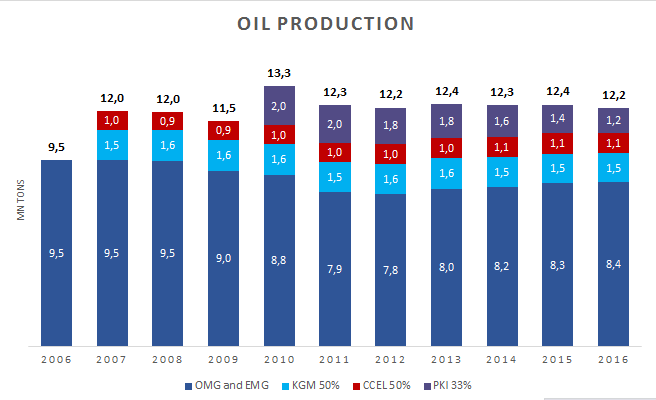
The core production assets of the KMG EP consist of two main divisions: JCS OzenMunaiGas (OMG) and JCS EmbaMunaiGas (EMG). OMG accounted for 70.6% of oil reserves at OMG and EMG (As of December 31, 2016) and 66.2% of total crude oil output from OMG and EMG in 2016. Currently, the oil production level of the existing fields has stabilised. Production enhancement technologies are being applied.
KMG EP’s core production operations take place across 41 fields at Ozen and Emba in Western Kazakhstan excluding acquisitions made from 2007 through 2011. One of the main tasks for the core assets is to maintain production levels by optimizing oil production and using new technology to maintain production level.
General economic difficulties and an acute lack of investment in the early to mid 1990s led to significant falls in production levels at the major oil-producing assets of KMG EP. However, towards the end of the 1990s the Company managed to halt the decline in production and then to ensure impressive production growth.
Production has risen by a total of 80% from 1998 to 2006. Enhanced investment in new drilling and more efficient recovery from existing fields has restored production levels. A major role in the recovery process was played by well workovers and the use of modern technologies such as hydro-fracturing. The Company’s strategy now is to maintain production from existing assets at the current optimal level for the next few years.
Kazgermunai
Kazgermunai was formed in 1993 with a view to attracting investment into the Republic of Kazakhstan from Germany. Under Kazgermunai’s Foundation Agreement, it was granted exclusive rights and licences for exploration and production at the Akshabulak, Nuraly and Aksai fields for a period of 30 years, expiring on 1 March 2024.
Kazgermunai currently operates the Akshabulak, Nuraly and Aksai oil fields. In total, Kazgermunai’s oil fields cover a territory of 897 km2. In 2016, Kazgermunai produced 1,5 million tonnes of crude oil.
CCEL (Karazhanbasmunai)
CITIC Canada Petroleum Limited (formerly Nations Energy Company Ltd) was formed in 1996 as a private Canadian company to pursue international oil and gas E&P projects around the world. In 1997, Nations Energy acquired 94.62% of the share capital representing 100% of voting control of JSC ‘‘Karazhanbasmunai’’ from the Government of Kazakhstan.
JSC Karazhanbasmunai holds 100% of the mineral rights until June 2020 to develop the Karazhanbas oil and gas field in the western part of Kazakhstan.In 2016 JSC Karazhanbasmunai produced 1.1 million tonnes of crude oil.
PetroKazakhstan Inc. (PKI)
The PetroKazakhstan Inc. group of companies is involved in hydrocarbon exploration and production as well as in the sale of oil and petroleum products. PKI has a share in 16 fields, 11 of which are in various stages of development.In 2016 PKI produced 1,2 million tonnes of crude oil.